I’m pleased to announce that Rumba Under Fire: The Arts of Survival from West Point to Delhi (Punctum Books, 2016) was reviewed in the Winter 2017 issue of Bitch Magazine. The issue is on newsstands now, and I’m happy to send a copy of the review to anyone interested.
Research Fellowships in Germany
Along with Berit Andersson, I’ve put together a list of research fellowships in Germany open to scholars in the humanities, along with a few tips for applying. You can find it at In the Middle here:
http://www.inthemedievalmiddle.com/2016/11/research-fellowships-in-germany-for.html
My favourite library
A few weeks ago I was asked by Zócalo Public Square to participate in a roundtable on “Why Libraries’ Survival Matters”. We were asked to write about our favourite library, and while I’ve loved many libraries, in only one of them did I have research help from angels.
Read my piece, and the whole roundtable, here:
http://www.zocalopublicsquare.org/2016/09/29/libraries-survival-matters/ideas/up-for-discussion/
Bad food in the Atlantic
I have a new piece up at the Atlantic online called “The Curious Appeal of ‘Bad’ Food.” It’s pretty exciting, as I’ve been using foodgonewrong.com for a while now as a space to play and think about what bad food means — and of course, about all the different ways food can be “bad.” I hope you enjoy the article!
CFP for special issue of Medieval Feminist Forum: Women’s Arts of the Body
CFP for special issue of Medieval Feminist Forum: Women’s Arts of the Body
Edited by Irina Dumitrescu (Rheinische Friedrich-Wilhelms-Universität Bonn)
Email: irinaalexandradumitrescu (at) gmail.com
At the beginning of Boethius’ Consolation of Philosophy, Philosophy arrives to drive out the Muses from Boethius’ cell. It is often said that the Philosophy is female because Latin philosophia is a feminine noun, and, indeed, the dialogue that follows continues a masculine tradition of inquiry and authorship. And yet, woven into this scene are not only female figures, but traces of women’s craft. Philosophy is a cloth-maker, having woven her own clothes, the Muses are described as actresses and whores, and both Muses and Philosophy aim to cure the sick Boethius with their healing arts. Although the dialogue that follows aims to teach the ailing man how to distance himself from worldly things, it begins with feminine craft and arts of the body.
For a special issue of Medieval Feminist Forum, contributions are invited that reflect on arts of the body associated in with women at any given point or place in the Middle Ages (with some flexibility towards the Renaissance). Such “arts of the body” might include: spinning and weaving; needlework, knitting, sewing, quilting; cooking, baking, confectionery; brewing, distilling; pottery; cosmetics, hair-dressing; dancing, singing, acting; medicine, home-remedies, first aid; making perfumes and poisons; birth control, abortion, midwifery; sex-work.
Some questions you might consider include:
– Which arts of the body are associated with women or men, and when?
– In what cases do arts or crafts that had belonged to women become the purview of men, or vice versa?
– How do women’s arts of the body intersect with race, class, sexual orientation, gender identity, or disability?
– How are women’s arts of the body appropriated as metaphors for men’s work?
– When does women’s work count as work? When does women’s art count as art?
– What biases do we find against feminine arts of the body, and how are they expressed in texts?
– Under what historical circumstances do feminine “arts of the body” make it onto the books? When are they institutionally recognized, inscribed, recorded, or even just mentioned?
– What effects do we notice due to the lack of a historical record? What kind of reconstruction or myth-making fills the archival gap?
– How have women’s arts of the body been taught or passed down? What can be recovered about women’s teaching practices?
– What kinds of gendered spaces are created or used for women’s arts of the body?
– What interpretative or historical tools can be used to recover and/or reconstruct lost arts of the body?
Format:
Full-length scholarly essays are welcomed from any discipline, and will undergo peer review. Also welcome for this issue are shorter creative or experimental pieces addressing the issue topic. Please submit an abstract or proposal (250 words maximum) for either kind of work by August 1, 2016 to irinaalexandradumitrescu (at) gmail.com .
Please feel free to get in touch via email if you have any questions about the topic or the feasibility of a particular approach or format.
Working timeline:
August 1, 2016 – Abstract deadline
September 1, 2016 – Essays solicited
January 1, 2017 – Drafts of solicited essays due
May 1, 2017 – Final drafts of accepted essays due
Fall 2017 – Projected publication date
On the value of the humanities in Zócalo Public Square
I’m thrilled that my argument for the humanities has now appeared in Zócalo Public Square:
An excerpt:
“We have been taught to think of the liberal arts as unnecessary and wasteful, or in Ronald Reagan’s words, “intellectual luxuries that perhaps we could do without.” Memoirs of the Romanian gulag showed me what a dangerous lie this is. Educated political prisoners drew on rich inner resources to preserve their sanity and their spirits. They used their knowledge to help their fellow inmates survive as well. Their experiences reveal what the attack on the humanities really is. It is an attack on the ability to think, criticize, and endure in crisis, and its virulence betrays how vital the liberal arts are.”
Read the rest here:
James Beard award nomination
I’m thrilled to announce that my essay, “My Father and the Wine,” published in the Yale Review, was nominated for the James Beard Foundation’s MFK Fisher Distinguished Writing Award. You can see all the nominees at the James Beard site!
California 2016
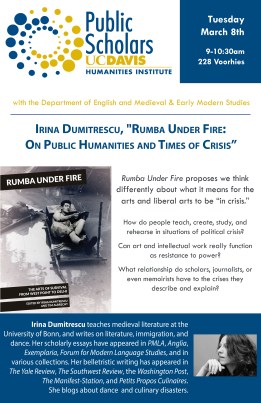
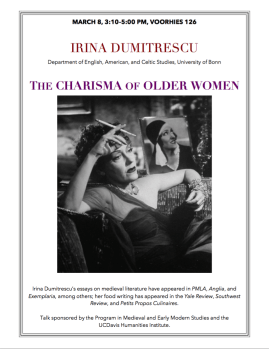
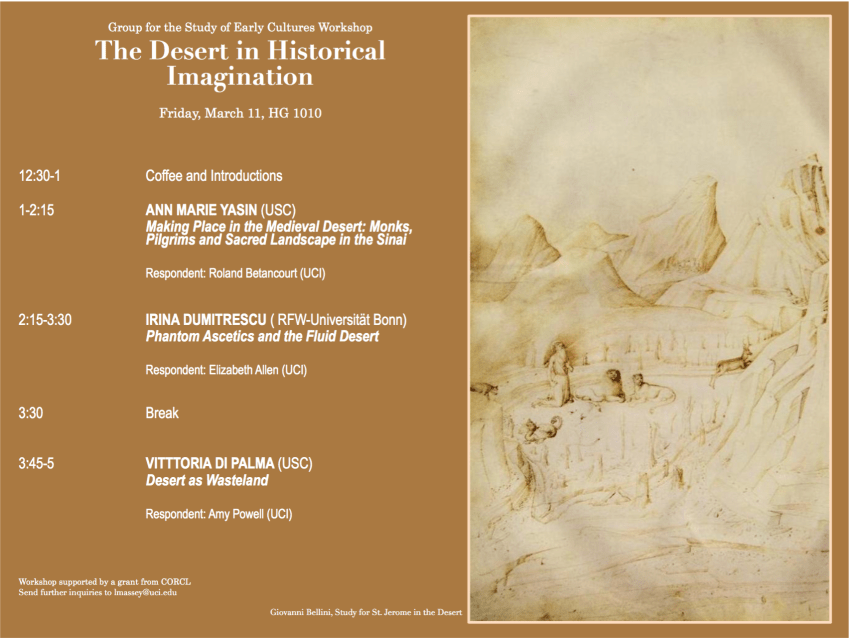
I just came back from a week giving talks around California, and meeting inspiring colleagues and friends all over the state. I particularly loved the posters (and would have collected them all had I been able to), which give a sense of the many mental landscapes we scholars inhabit through our work.

General-Anzeiger, Bonn
The General-Anzeiger, the major newspaper of Bonn, recently reported on the new members of theNorth Rhine-Westphalian Academy of Sciences, Humanities and the Arts. Here is the article clip:

North Rhine-Westphalian Academy of Sciences, Humanities and the Arts
I’m delighted to announce that I’ve been inducted into the Junior College of the North Rhine-Westphalian Academy of Sciences, Humanities and the Arts. Here is the press release, and a group photo of the new inductees and the NRW minister of innovation, science, and research, Svenja Schulze.
The press release at the University of Bonn can be read here.
 Irina Dumitrescu